Gigaphoton: VR Training for Semiconductor Equipment Maintenance
Development of a custom AI narrated, Virtual Reality based training system that allows users to train in the maintenance of hazardous equipment from a safe, multi-user, virtual space.
Gigaphoton: VR Training for Semiconductor Equipment Maintenance
Development of a custom AI narrated, Virtual Reality based training system that allows users to train in the maintenance of hazardous equipment from a safe, multi-user, virtual space.
For engineers learning to maintain complex equipment, understanding the instructions is one part of preparation. They also need opportunities to work through the sequence, handle the tools, and become familiar with the components involved. Providing that practice on physical equipment depends on access to the machine and to the people who can teach the procedure.
Gigaphoton, which develops light sources used in semiconductor lithography, worked with SLIDEFACTORY to bring maintenance training into virtual reality. The project would give engineers a way to practice procedures on virtual equipment, including guided instruction and opportunities to work more independently.
Those dependencies are what the project was built to work around. Conventional training for this kind of maintenance is shaped by exposure to the physical equipment, by safety considerations, by travel, and by whether a machine is available to train on rather than in service. A virtual setting changes which of those constraints apply on a given day.
Gigaphoton has been public about the direction. Its own materials describe comprehensive operation and maintenance training as essential to its service organization, and identify VR and AR training as part of improving field-service engineer skills worldwide.
Our involvement began with the real training process. We spent time onsite observing instruction and handling the tools before translating that work into a virtual experience. The initial system took roughly 3 months to develop, beginning a relationship that has continued for more than 5 years.
Understanding the Procedure Before Building the Simulation
The first task was to understand what an engineer needed to do. Our team observed live training, documented the procedures step by step, and worked through the material with Gigaphoton to organize it into training modules.
Working from the real procedure rather than from documentation mattered for a practical reason. The things that make a maintenance task difficult, the order operations have to happen in, the component that is awkward to reach, the step people most often get wrong, are learned by watching someone do it.
That work gave the design and development team a shared reference for the experience. Each procedure had to become a sequence a learner could follow inside a headset: which component to interact with, which action to take, and when to move forward. The training content, the virtual equipment and the guidance all needed to support the same sequence.
We worked with Gigaphoton’s team through translators as part of the collaboration. Reviewing the procedures together helped keep the technical material and the intended training experience connected throughout development.
Building the Equipment Around the Task
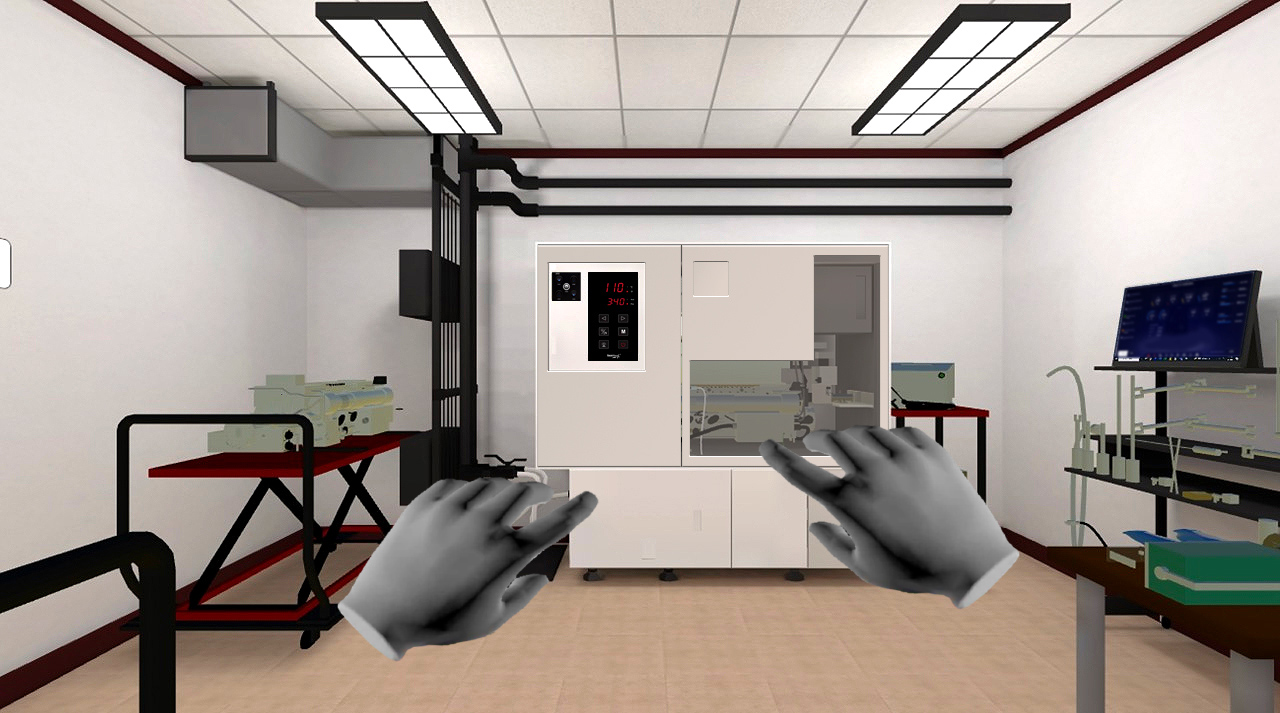
SLIDEFACTORY created 3D representations based on Gigaphoton’s real equipment, developed as digital clones of the products as they exist onsite, along with the interactions used to carry out the training procedures. Learners could work with components in the virtual environment, including the disassembly and handling actions needed for the scenarios.
The visual approach was stylized, with attention directed toward the equipment and actions relevant to the training. This also required balancing the detail of the models with the performance demands of a headset. The environment needed to support interaction with the machinery while remaining usable as a VR experience.
Alongside the 3D work, we developed the concept, the scripts, the interface and the tutorial system that guided learners through the procedure. Those elements were designed together so the instruction referred to what the learner could see and do in front of them.
Writing that instruction was its own piece of work. A procedure an experienced technician performs in one continuous motion has to become discrete steps a system can present, check and wait on, without breaking it into so many pieces that the shape of the job disappears.
Moving From Guided Instruction to Independent Practice
Guided training introduced procedures one step at a time, using narration and prompts to support each action. It gave learners a structured route through the scenario and a way to become familiar with its sequence.
As the engagement continued, the training expanded to include a free-flow mode. With the step-by-step prompts removed, learners could work through the equipment more independently. The two modes supported different forms of practice within the same virtual setting.
Across the engagement, SLIDEFACTORY produced 3 to 4 training scenarios in total, covering both modes.
Multi-user functionality extended the experience to shared sessions. Participants in Japan and the United States could join the same virtual space and work through the equipment together. This made remote collaboration part of the training experience, alongside individual practice.
Shared sessions also support something individual practice does not. Coordinating with another person while you work is its own skill, and a session in the same virtual space lets an experienced engineer watch a newer one work through a procedure.
Developing the Training Over Time
The first release established the training environment and guided scenarios. Over the following years, our work with Gigaphoton included additional training paths, narration updates, and an environment that could accommodate changes to the modules.
The environment was built to be configurable and expandable, so modules could be adjusted or added as the equipment and the training changed. Over an engagement measured in years, that matters more than anything in the first release.
Narration across the tutorials is AI-generated, using voice replication so the delivery stays consistent from one module to the next. Consistency matters more than performance here. A learner moving between scenarios should not be adjusting to a different narrator each time.
That continuing involvement connected new development with the procedures and interactions already in place. A change to the instruction needed to be reflected in the scenario. A new way of practicing needed support from the tutorial system and interface. Our role covered those connected parts of the product, from training content and 3D assets to software development.
The resulting system gives Gigaphoton a virtual setting for practicing equipment maintenance, with guided instruction, independent exploration and shared sessions. It creates opportunities to rehearse the work without operating the physical machine during that session, while leaving the training team to determine how VR fits into the wider preparation of its engineers.
This project sits alongside our wider education and training software work, where the subject changes but the underlying problem rarely does.
Talk With Us About Your Training Challenge
If you are considering VR for a technical procedure or a hands-on training program, we can help evaluate what should be simulated and develop the experience around it. Bring us the task people need to learn and the constraints around practicing it.
Frequently Asked Questions
What did SLIDEFACTORY develop for Gigaphoton?
The concept, script and design for the VR tutorial, 3D asset development based on Gigaphoton’s real equipment, the VR training development itself, the AI narration and tutorial system, guided and free-flow training modes, multi-user training across locations in Japan and the United States, and the VR user experience and design.
How long has the project run?
The initial system took roughly three months to develop, including the onsite work that preceded development. The relationship has continued for more than five years, with additional training paths, narration updates and an expandable environment added after the first release.
What is the difference between guided and free-flow VR training?
Guided training introduces a procedure one step at a time, with narration and prompts supporting each action. Free-flow training removes those prompts so a learner can work through the equipment more independently. Across the engagement SLIDEFACTORY produced three to four training scenarios covering both modes.
How closely does the virtual equipment match the real machine?
The 3D work is based on Gigaphoton’s real equipment, developed as digital clones of the products as they exist onsite. The visual approach is stylized rather than photoreal, directing attention toward the components and actions relevant to the training while staying within the performance limits of a headset.
Can people in different countries train together?
Yes. Multi-user functionality supports shared sessions, with participants in Japan and the United States joining the same virtual space and working through the equipment together, alongside individual practice.